The Five Evasions in Education




The American K-12 system is at odds with its own purpose: intellectual training. We manage our largest school districts, tasked with educating most of the nation's students from low-income families, so as to virtually ensure their failure. We decry the vast gaps in achievement between rich and poor, black and white. But our schools seem unserious about academic excellence and scornful of intellect.
This attitude has an unfortunate heritage in our country, as the historian Richard Hofstadter chronicled in his magisterial 1963 appraisal, Anti-Intellectualism in American Life. From the start of the common school in America, Horace Mann and other proponents of mass education stressed not the development of the mind or pride in learning for its own sake, but rather education's economic, moral, and political benefits. In the 19th-century common school, American heroes like George Washington were depicted as sincere, self-made men with little use for intellectual life: "He was more solid than brilliant, and had more judgment than genius. He had great dread of public life, cared little for books, and possessed no library," said one history book. "Man's intellect," students read in one school anthology, "is not man's sole nor best adorning." The world of ideas and learning for enjoyment suffered suspicion; industriousness garnered more esteem than did intellect.
The American distaste for an academic education — and distrust of intellectualism — continues to plague our public schools. More than half a century after Hofstadter wrote, professional educators display a restless tendency to stray from their schools' academic purpose. Evading their responsibility to ensure that every child is educated — literate, numerate, widely read, and knowledgeable — they invoke alternative purposes for schooling: the therapeutic, the instrumental, the technological, the futuristic, or the political evasions. Or, defeated in their core responsibility to educate, they veer toward a kind of nihilism.
Any attempt to remedy American educational underachievement, or to expand opportunity for the marginalized, must begin by forswearing these evasions and recommitting to academic excellence for its own sake.
THE THERAPEUTIC EVASION
In the Poudre School District of Fort Collins, Colorado, the director of language, culture, and equity questioned whether an academically rigorous summer-school program should be implemented because one novel that students read depicts a death in the family. The district would not have mental-health staff at each individual site, he explained. At Poudre, as in many American schools today, educators find themselves more passionate about attending to the social and emotional needs of their students than about educating them.
Time and again, educators return to the claim that students who feel good about themselves fare well in school, despite decades of studies finding little or no evidence of such causality. Yet the reverse is reliably true: Students' self-esteem grows when effective teaching affords them regular experiences of academic success. When every class leaves children buoyed by a small advance, the cumulative effect of these experiences is transformational to a child's self-regard. Students come to think they are good at school.
Few schools are managed to ensure such experiences, for they require relentless attention to instructional design and execution. It is far easier to replace academics with warmth and caring and, often, a curriculum that seeks to advance self-esteem.
The most notorious large-scale therapeutic evasion in American education accompanied the self-esteem movement of the early 1990s. The California Department of Education's much-publicized 1990 task-force report, Toward a State of Esteem, called self-esteem
a social vaccine...that empowers us to live responsibly and inoculates us against the lures of crime, violence, substance abuse, teen pregnancy, child abuse, chronic welfare dependency, and educational failure.
Inspired by the report, teachers showered students with happy-face stickers. One Illinois school draped itself in a banner reading, "WE APPLAUD OURSELVES." A Massachusetts school district required students to skip without real ropes to avert a loss of self-esteem from tripping. President Bill Clinton endorsed the report; Oprah Winfrey ran a prime-time special on it. Four months after the report was issued, 86% of California's elementary schools provided self-esteem programming.
Yet the state's student outcomes remained far below the national average, and the report's basis in academic research was later exposed as fraudulent. A 346-page study on which the task force's recommendations were ostensibly based, published by seven University of California professors in 1989, did not support its extravagant claims. Neil Smelser, a professor of sociology at Berkeley, summarized the findings of his fellow academics in the report's introduction: "The news most consistently reported," he wrote, "is that the association between self-esteem and its expected consequences are mixed, insignificant or absent," and "even less can be said for the causal relationship between the two."
The Therapeutic Evasion sustains the foremost problem in American schools — the underestimation of students' academic capacities — and its corollary, the tendency to place before them learning tasks that are not worthy of them. The education-research and consulting organization The New Teacher Project (TNTP) documented this in its 2018 report The Opportunity Myth. Analyzing nearly a thousand lesson plans from urban schools, TNTP found that most contained material far below grade level. Teachers who respect children believe in them and push them. Poorly constructed tasks with below-grade-level content deny educational opportunity.
In the wake of the Covid-19 pandemic, the Therapeutic Evasion exerted particular allure. The abrupt shuttering of schools upended students' daily routines and social lives. When schools reopened and students returned, they were not the same; 18 months of isolation had taken a grievous toll. The data on student learning loss were chilling. Teachers urgently needed to make up lost ground academically, to radically accelerate learning and ask far more of their students.
But how, in these circumstances, could teachers' attention not turn to their students' safety and emotional needs — to the therapeutic? "Teachers by nature are the type of people who are nurturers," one teacher explained. "I'd rather help kids and families through the pandemic and not focus on academics," said another. Teaching is a helping profession, and the caring and compassionate are drawn to it.
As districts recovered from the pandemic, calls mounted for social-emotional learning and "trauma-infused practices" in schools. But such practices may do more harm than good. A social-emotional-skills training program called WISE Teens provides eight classes led by clinical psychologists in training. Students are taught to manage their emotions with a variety of psychological techniques that emphasize both acceptance and behavior change. In a study of 1,071 teenagers in four high schools in Sydney, Australia, in 2017 and 2018, half participated in the WISE Teens program, while the other half received a conventional health curriculum. Compared with the control group, WISE Teens participants reported higher rates of anxiety and depression, greater difficulty managing their emotions, lower quality of life, and worse relationships with their parents.
The attempt to increase students' awareness of mental-health challenges may have caused them to interpret everyday life struggles as pathologies. "[L]abelling distress as a mental health problem can affect an individual's self-concept and behaviour in a way that is ultimately self-fulfilling," write Lucy Foulkes and Jack Andrews. "[I]nterpreting low levels of anxiety as symptomatic of an anxiety disorder might lead to behavioural avoidance, which can further exacerbate anxiety symptoms." Social media barrage children with posts about anxiety; it isn't helpful for them to encounter similar messaging in the classroom.
"Trauma-based education" is equally problematic. The promiscuous designation of children as "traumatized" misidentifies the origins of their distress, diverts attention from improving instruction, and encourages teachers to function as therapists, for which they are not trained. In a vicious cycle, ineffective instruction exacerbates student disengagement and antisocial behavior as the frustration and shame of repeated academic failure grow. All the while, student agency and resilience diminish.
In the fight for social justice, the invocation of "trauma" resonates deeply. Many children in urban schools have in fact been scarred by the pandemic's disparate impacts on people of color and by gun violence, poverty, and homelessness.
"Adverse childhood experiences" including violence, parental separation, and divorce are correlated with serious negative consequences for children's cognitive, emotional, and social functioning. Public policy must seek to reduce children's exposure to violence in every form and setting, particularly in marginalized communities.
But how should schools address these problems? When all students who have suffered hardship are deemed traumatized, we invite reduced expectations. And if implemented poorly, trauma-informed practices can erode children's functioning and restrict their flourishing.
"Trauma experts" tell us no one is "untouched by trauma" and describe it as an "indivisible part of human existence," one that "takes many forms but spares no one." But Columbia psychologist George Bonanno contends that most people exposed to potentially traumatic events, no matter how awful, return to normality after a period of struggle. While clinical research has focused on the minority who have sustained adverse reactions, Bonanno urges the study of the far greater number who recover. These individuals exhibit specific behaviors — optimism, confidence, and an orientation to challenge — that place them on a "resilience trajectory." While some people are more inclined to these behaviors than others, he argues they are skills anyone can cultivate.
Undeniably, students from impoverished families face immense adversity. But medicalizing their condition doesn't help most of them. Capacious definitions of trauma and psychopathology encourage the Therapeutic Evasion and divert attention away from ensuring effective instruction. Schools should instead strive to build optimism, confidence, and receptivity to challenge in their students — to emphasize that they can get through the obstacles before them. This is not to minimize what they have endured but to respect their capacities.
Elevating the therapeutic also drives resistance to measuring the efficacy of schools and teachers in educating. When educators talk of "educating the whole child" and using "multiple measures of success," they aim to give equal standing to schools' therapeutic and educational functions. Children's social and emotional needs are being met, even if test scores remain dismal.
The perennial challenge for American schools is to insist that high expectations for learning are not in conflict with caring for children; they are in alignment. That may be a result, in part, of our national strategy for staffing schools. Countries whose school systems consistently perform at the top of international assessments — Singapore and South Korea — recruit teachers from the top third of their academic cohort. American schools, by contrast, draw just 23% of new teachers from the top third of their cohort, and in our high-poverty schools, only 14%.
American schools are staffed largely by teachers from the bottom half of their high-school class. If America's teachers were themselves frustrated and unhappy in school, denied the experience of strong, high-expectations teaching and academic success, they may want to spare their students that pain. They may hold little allegiance to intellectual rigor. Sympathy can displace expectation. What begins as compassion may end in harm.
Educators who succumb to the Therapeutic Evasion fail to acknowledge that good education is often discomfiting. Learning entails intellectual struggle. All good teaching exposes students to ideas that challenge their beliefs and preconceptions; we should not deny them this experience. Schools must not cater to fragility. Instead, they should build courage and fortitude.
THE INSTRUMENTAL EVASION
The Instrumental Evasion misconceives education in a different way, as a means to an end, a ticket to a career, an engine of social mobility. Job preparation and "life skills" supersede an academic education; intellectual growth has no value if it cannot be commercialized. Parents, concerned that their children prosper in the workplace, may accept the substitution. But even by the measure of financial gain, the Instrumental Evasion shortchanges students, depriving them of the rewards of broad intellectual training.
Since the country's founding, Americans have prized practical intelligence, the life of action and decision. As Hofstadter noted, this was not propitious for contemplation, deliberation, or precision in thought. In the 20th century, business leaders found common cause with school administrators who belittled intellect in favor of vocational and "life" skills. A progressive education system would "adjust" students for their roles in American life.
Black students fared the worst under the new educational regimen. In 1916, a half-century after slavery's end, the federal government issued a 1,100-page report on the education of the country's black population, prepared by former social worker Thomas Jesse Jones. The report decried the "wretched" condition of school facilities for black children, the lack of education and training of their teachers, and the immense resource disparities relative to schools for white students.
But it also admonished black leaders for preferring an academic education over the agricultural and industrial training Jones favored. "[A] large number of the colored leaders have been much more eager for the literary and collegiate type of school than for the teacher-training, agricultural, or industrial institutions," Jones wrote, lamenting the time schools for black students devoted to foreign languages, especially Greek and Latin. "[T]he primary need is emphatically for a knowledge of gardening, small farming, and the simple industries required in farming communities," Jones asserted. He added the race-essentialist claim that black people's "highly emotional nature" requires an emphasis on "the concrete and the definite."
W.E.B. Du Bois issued a blistering response to Jones's report in the NAACP's journal, The Crisis. "Anyone, who suggests by sneering at books and 'literary courses' that the great heritage of human thought ought to be displaced simply for the reason of teaching the technique of modern industry is pitifully wrong," he wrote. "[T]he object of a school system is to carry the child as far as possible in its knowledge of the accumulated wisdom of the world and then when economic or physical reasons demand that this education must stop, vocational training to prepare for life work should follow."
A century after Du Bois wrote, the Instrumental Evasion is again ascendant. On college campuses, the turn away from liberal education, the atrophy of humanities departments, and the overspecialization of campus research robs graduates of a strong general education.
Advocates of an education grounded in science, technology, engineering, and math (STEM) claim it prepares students for high-paying jobs in 21st-century professions, including computer science. The K–12 system increasingly privileges STEM over the humanities. But predicting which skills will be in demand years before students enter the workplace is hazardous — especially given the bewildering speed of technology's development. Ten years ago, districts and organizations like Girls Who Code rushed to prepare students to write software. Now we know that computer-programming jobs are particularly vulnerable to being replaced by artificial intelligence.
Meanwhile, robust evidence has revealed an impressive return on investment from a liberal-arts education. Though confounding variables complicate matters, one study showed that the median 40-year return on investment from four-year liberal-arts colleges is comparable to that from four-year engineering and technology institutions. Engineering graduates receive handsome starting compensation, but the value of even the most advanced computer scientists is ephemeral, as their employers turn to new graduates with the most current expertise. Skills obsolescence means their earnings advantage fades as they age.
By contrast, the invaluable abilities to distinguish fact from opinion, organize a logical argument, think creatively, and express oneself orally and in writing with clarity and verve — all of which a good liberal education bestows — never suffer obsolescence. Rather, these capacities equip liberal-arts graduates for high-paying positions by mid-career in management, law, and other fields, offering students durable advantages in work and in life. They are gained through exposure to a broad and rich curriculum, through the accretion of specific knowledge and concepts from the earliest grades.
Philosopher Martha Nussbaum has warned how the demands of the global economy threaten to eclipse essential human abilities that undergird justice and peace. She invokes the Indian philosopher and educator Rabindranath Tagore, who a hundred years ago already feared that the moral person was giving way to the commercial person, "causing the upset of man's moral balance, obscuring his human side under the shadow of soul-less organization." A liberal education may in 20 years be a "distant memory," Nussbaum surmised in 2010. A decade and a half later, tribalism and enmity threaten democracies around the world. A liberal education is the essential bulwark.
The economic returns from schooling will always be of paramount concern to students and their families, but employment is not education's sole purpose. Education aims at human flourishing, the construction of lives of meaning and purpose. The Instrumental Evasion will always be seductive, but a rich education is its own end.
THE TECHNOLOGICAL EVASION
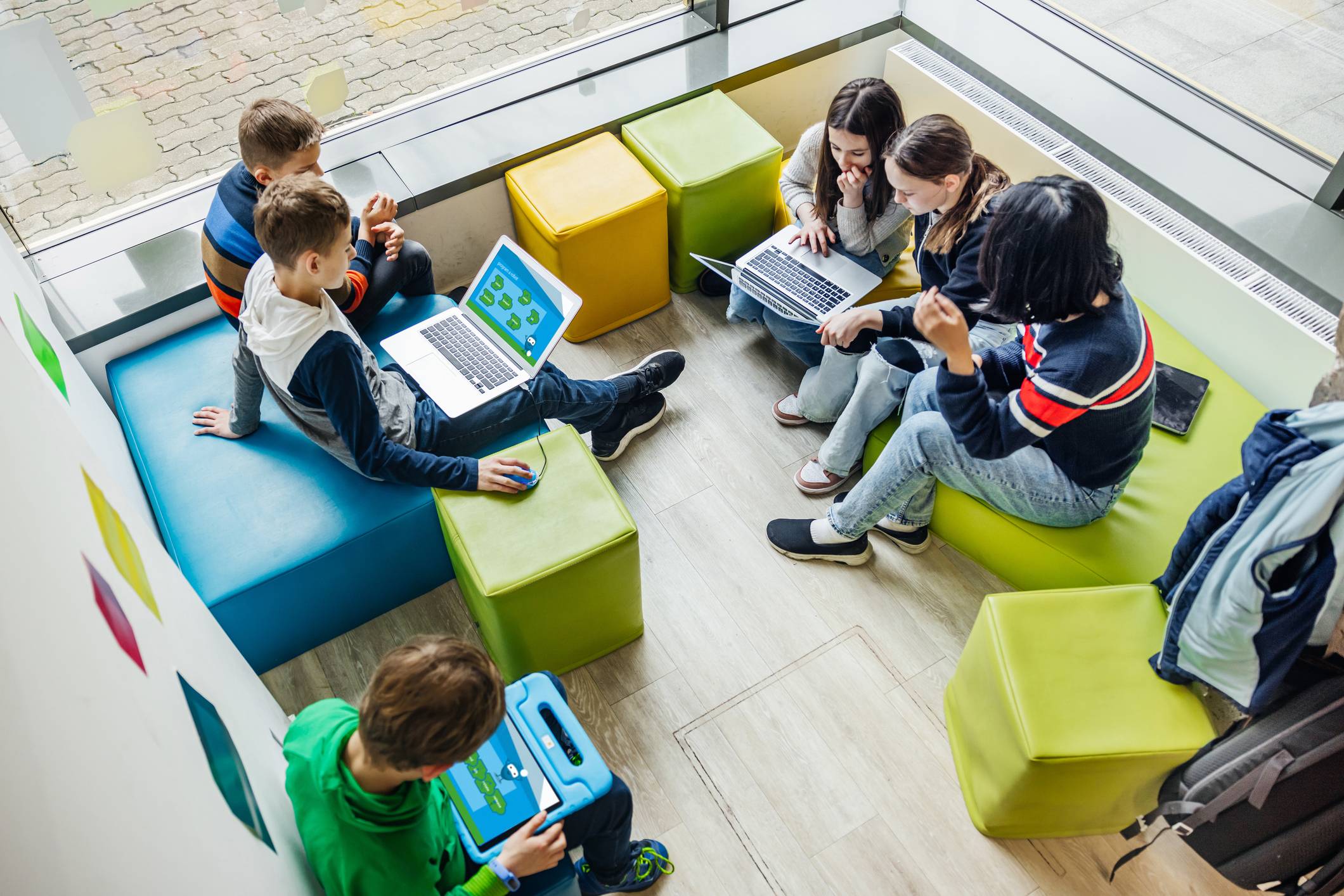
Every few years, a technology entrepreneur discovers schools and proposes to "reinvent" them. Investment and credulous media coverage follow, despite the project's uncanny resemblance to earlier failed efforts, of which everyone involved — founders, investors, and journalists — seems unaware. Conventional learning is cast as drudgery; school will be made "fun," and children will learn naturally and with little effort, aided by novel technology. But the satisfactions of learning are more profound; they're reached through productive struggle, which recasting learning as a game thwarts rather than enables.
In 2013, Google technologist Max Ventilla launched AltSchool, a network of schools that would set a new standard for high-tech personalization. "Students shouldn't just be cogs in a wheel. They should be agents of their own goals," he explained to Forbes. Children would pursue their own interests. They would not be confined to grades. Technology would be everywhere. Investors purred. "He was talking about a shift from a lecture-based model of education to a learner-centric model," said Josh Kopelman, an investor and board member. "That made total sense to us." Mark Zuckerberg, Peter Thiel, and three other billionaires invested $174 million at a nearly half-billion-dollar valuation. But just a few years later, AltSchool began to shutter locations. By 2019, it had ceased operating schools directly.
Silicon Valley education entrepreneurs using corporate gobbledygook to hawk technological miracles has long been a distraction in the K–12 world. Festooning classrooms with audiovisual technology, bridging the "digital divide," equipping every child with a tablet or a laptop, installing interactive whiteboards and virtual-reality headsets — each vision for "transforming" teaching and learning soon proved chimerical. Before the pandemic, American schools spent an estimated $26 to $41 billion annually on technology; post-pandemic annual spending may reach $50 billion.
These projects consume a grossly disproportionate share of capital and talent in the education sector. If technology could deliver dramatic learning gains, millions of children would benefit. As yet, however, the results are discouraging. Recent reviews of research on elementary reading find near-zero effects from technology-assisted approaches. Those on elementary math find only slightly better.
Enduring misconceptions plague education technology: Technology, it is said, is "cool." It makes learning interesting. It drives sustained student engagement. It enables students to learn faster while working independently. Today's children "multi-task" naturally, building their "brain muscle" for today's frenetic world. In truth, dull and poorly crafted lessons are no more engaging or effective for being transferred to screens, and the allure of sleek technology to students is fleeting if it doesn't result in the satisfaction of learning gains. Distractions and switching tasks erode children's focus today just as readily as they have for every generation; productivity comes from the ability to concentrate.
There is the rare success. Khan Academy's videos, which originally captured founder Sal Khan's exceptionally lucid presentations of mathematical and scientific concepts on an electronic blackboard, have produced substantial gains for students. But most will continue to learn best in a social setting with other students and a teacher who knows and inspires them — and expects things from them. Technology can supplement teacher-led instruction by offering additional practice or the opportunity to satisfy emerging curiosities. But, for core instruction, placing students in front of a device generates few returns. When educational technologists examine the use of their products in actual classrooms, they find that only about one-third of students are doing the thinking the product requires of them and progressing through lessons. The remainder are just clicking about randomly.
Unsurprisingly, Silicon Valley executives keep computers out of their own children's hands — and schools. The Waldorf School of the Peninsula, popular among Silicon Valley's wealthy technologists, avers that exposing students to technology earlier than the seventh grade "can hamper their ability to fully develop strong bodies, healthy habits of discipline and self-control, fluency with creative and artistic expression, and flexible and agile minds." Alan Eagle, a parent at the school who works at Google and has written speeches for its former chairman, Eric Schmidt, said, "I fundamentally reject the notion you need technology aids in grammar school." In her 2020 memoir, Untamed, writer Glennon Doyle describes talking to a Silicon Valley executive who had been instrumental in the development and proliferation of cell phones. "I asked how old her kids had been when she'd bought them phones. She laughed and said, 'Oh, my kids don't have phones.'"
None of this slowed Silicon Valley investors' and philanthropists' push to substitute computers for human teachers. In the 2010s, investment in "personalized learning" by technology billionaires' newly created funds swamped investment in all other school-reform strategies combined. Consider Zuckerberg's investments alone. He and his wife, Priscilla Chan, announced in 2016 that over their lifetimes, they would give 99% of their Facebook shares — then estimated to be worth $45 billion — to three causes, of which personalized learning was the first.
In the AI age, this Technological Evasion remains as seductive as ever. Could AI prove the long-awaited game changer in educational technology, by both personalizing instruction to students' deficits and simulating the personal attention, patience, and care of a dedicated human tutor? It's impossible to predict its effects, but a sober assessment reveals that it threatens students' intellectual, social, and moral development. Large-scale randomized trials of generative AI learning tools show that students, unsurprisingly, write or calculate better with their aid, but when the tools are withdrawn, they perform no better or worse than students who relied on their own faculties. Intellectual growth comes from struggle; relieving children of that struggle stunts them. Writing, in particular, is indispensable to learning how to think, reason, and communicate persuasively. But chatbots are composing students' essays, and teachers are deploying AI to read and evaluate them. Computers are talking to computers.
We must also weigh potential psychological harms. By 2015, teenagers were already glued to their devices for a staggering daily average of nine hours — more time than they spend sleeping or in school. Their peers from low-income families spend almost an additional three hours glued to theirs.
Passing still more time in front of a device, even if in service of learning, will deprive students of social interaction and deepen anomie, anxiety, and depression. In 2023, the United States surgeon general issued a formal warning about the "profound risk of harm" social media poses "to the mental health and well-being of children and adolescents." A longitudinal study cited in the advisory found that "adolescents who spend more than 3 hours per day on social media face double the risk of experiencing poor mental-health outcomes, including symptoms of depression and anxiety."
Will chatbot tutoring tools further imperil children's mental health by socially and intellectually isolating them from their classroom peers, catering to their existing interests and prejudices, denying them vital relationships with human teachers, and doling out algorithmically determined affirmation? AI tutoring systems show promise, but they may exacerbate inequality, not remedy it. If such systems are widely adopted in urban school systems, already marginalized students of color may have to settle for an educational simulacrum while middle-class students continue to benefit from real teachers. And as white-collar jobs are automated and the economy is restructured, students of every background and identity who don't develop the distinctively human faculties that AI lacks risk being left on the sidelines. The arrival of AI should serve as a clarion call to educators to cultivate their students' moral capacity to engage others' views, wrestle with complex questions, and seek truth — to offer all students a liberal education.
As historian Johann Neem has argued, technology can never substitute for the "inspiring, often unexpected conversations" students have with their teachers and among themselves. Computers "are not interpretative moral beings," he notes: They lack any capacity to evaluate students' reflections on complex ideas or their positing of new ones. "Fundamentally, computers cannot cultivate curiosity because machines are not curious." We should be skeptical, then, of their ability to transform classrooms for the better.
THE FUTURISTIC EVASION
The world's knowledge is expanding so quickly, some in the education professoriate contend, that schools should focus less on transmitting specific knowledge than on teaching children how to "access" the knowledge they need as "lifelong learners." Equipping children with "21st-century skills" is more important than teaching them academic "content," which itself should engage "21st-century themes." By redefining the goals of schooling, the Futuristic Evasion exonerates schools from their failure to offer a rigorous academic education.
In 2002, a coalition of education leaders, policymakers, and corporations — including the National Education Association, the U.S. Department of Education, Apple, and Microsoft — formed the Partnership for 21st Century Learning. To ensure the "21st century readiness" of students, the partnership effectively demoted academic learning ("key subjects") to just one of many "21st century themes." These included "Global Awareness," "Financial, Economic, Business, and Entrepreneurial Literacy," "Civic Literacy," "Health Literacy," and "Environmental Literacy." Other categories included "learning and innovation skills," "information, media, [and] technology skills," and "life and career skills." Particular attention went toward "7C skills": critical thinking; creativity; collaboration; communications, information, and media literacy; computing; cross-cultural understanding; and "career and learning self-reliance." When academic subjects are taught, "21st century interdisciplinary themes" are to be woven through them.
Time is scarce in schools; asking teachers to do more comes at a cost. The partnership's dilution of the academic disciplines ensures that children in schools abiding by its directives will be left less educated. But the proposal's flaws run deeper.
The Futuristic Evasion rests on several misconceptions. First, it is not apparent that the pace at which the world is changing is unprecedented, or that students are therefore less prepared to cope with such change than past generations. The last decades of the 19th century, for instance, witnessed the invention of the electric light, the automobile, the telephone, the phonograph, radio, movies, and the electric streetcar, at a time when thousands of blocks of American cities were built. Furthermore, while human knowledge is expanding quickly, in constructing an academic curriculum, it is neither arbitrary nor futile to select from that knowledge what students most need to learn. A student who mastered the academic curriculum of the 1960s would be reasonably well equipped today; the foundational knowledge students need has little changed. Schools abdicate their responsibility when they replace education with procedures for "accessing" facts and data. To obtain facts is not to acquire knowledge, still less to achieve understanding.
Second, many of the capacities promoted by the Partnership for 21st Century Learning cannot be taught discretely. Consider critical thinking. As E. D. Hirsch has argued for a half-century, one can't think critically without an arsenal of knowledge. In his 2022 book What Is Wrong with Our Schools? Daniel Buck recounts screening a documentary on the Great Depression for his freshman high-school students. When he asked the class why some Americans had moved to the Soviet Union in search of work, he was met with an inexplicable silence. At last, a student spoke. "Is the Soviet Union a country?" Lacking any knowledge about the World Wars and the Cold War, his class could not "access" the topic under discussion. "How could I possibly ask them to think critically about the Great Depression and the Soviet Union when they knew next to nothing about it?" Buck writes. "I might as well ask them to water a garden with an empty pail." Not only is it ineffective to ask students to opine or "think critically" about things they know nothing about; it's condescending and disrespectful.
It is equally futile to attempt teaching "creativity" in isolation. When knowledge and ideas from disparate fields collide, creativity is sparked. It is the broadly educated student whose mind comes alive with new and curious conceptions. "Cross-Cultural Skills," another emphasis of the partnership, have no more reliable agent than literature. In the characters of novels set in distant times or foreign places, we discover our shared humanity. And, equipped with an effective education, students will find it trivial to learn on their own how to use Google Docs or the latest device.
The purpose of education is not ultimately the mastery of specific "skills," but rather an encounter with ideas and the development of intellectual and moral capacities. When confronted with disruptive social, economic, and technological change, schools' proper response, as Neem emphasizes, is not to turn away from their responsibility for intellectual refuge and reflection, but to recommit to it. "To run from forces that seem too large to counter is human," he writes, "but this response should not be mistaken for fortitude or moral courage."
THE POLITICAL EVASION
Visit a new teacher's classroom, and on the bookshelf behind her desk, you're likely to find a handful of books from education school, cherished influences and markers of commitment. Jonathan Kozol's Savage Inequalities. Lisa Delpit's Other People's Children. And Paulo Freire's Pedagogy of the Oppressed.
Freire, a Brazilian philosopher and teacher, first published his book in 1968; the English edition arrived in 1970. A half-century later, the book had sold over a million copies, an extraordinary success for a theoretical tract on education. How to explain its reach? In a 2003 analysis of the syllabi of 16 top-ranked American education schools, researchers David Steiner and Susan Rozen found that Pedagogy of the Oppressed was one of the most assigned books in education-foundations classes.
For a book ostensibly on the remaking of education, Freire had remarkably little to say about how schools should be run — what subjects and content children should be taught and at what age and with what methods, or how to raise achievement, especially among marginalized groups, in the service of equality of opportunity.
Freire condemned traditional teacher-led education as a "banking" model, an act of domination where the teacher "makes deposits" into students, reducing them to "containers" or "receptacles" to be filled. The more students accept this passive role, the more they adapt to the world as it is rather than seeking to transform it.
In contrast with the banking model, Freire's "liberating education" engages teachers and students in a mutual quest for "humanization." The student-teacher "contradiction" is resolved, rendering the "teacher-student" and the "student-teacher" coequals in a pedagogy of "problem-posing." Education becomes the practice of freedom rather than of domination. Students and teachers alike come to see the world not as an objective reality, but as reality in process, in transformation. Freire announces "critical pedagogy," which has dominated education schools ever since.
But does Freire's problem-posing dialogue truly free students to think for themselves? As literary critic Gerald Graff has argued, "however much Freire insists on 'problem-posing' rather than 'banking' education...for Freire only Marxism or some version of Leftist radicalism counts as a genuine 'critical perception.'" It never occurred to Freire that a student might authentically believe or strive for something at odds with his views; this he dismissed as "false consciousness." The inherent inequality in power and experience between students and their teachers, Graff notes, often makes students fearful of challenging their teachers' political views. "What right do we have to be the self-appointed political conscience of our students?" he asks.
Freire described a Manichaean society of "oppressors" and "oppressed," where teachers are unwittingly complicit in maintaining the oppressive order. Students, whom Freire analogized to slaves, accept their ignorance with a fatalistic attitude and fail to perceive injustice. The task of teachers is to awaken their students' "critical consciousness" so that they shed their false consciousness, recognize their oppression, and work toward their liberation. Liberation entails violent struggle to overthrow capitalist hegemony and establish a socialist utopia. That violence, Freire said, will be an "act of love."
Freire saw the liberation he sought achieved in Mao's China. After the first stage of the pedagogy of the oppressed, where the oppressed "unveil the world of oppression," comes the second stage, where "the reality of oppression has already been transformed," and "this pedagogy ceases to belong to the oppressed and becomes a pedagogy of all people in the process of permanent liberation." This "appears to be the fundamental aspect of Mao's Cultural Revolution." It's an astonishing statement. When Freire's book was published in the United States, Chinese teachers and intellectuals were suffering persecution as schools and universities closed under duress. By some estimates, the Cultural Revolution's orgy of chaos and violence claimed the lives of millions.
Even on Freire's revolutionary terms, his educational vision fails. Students cannot think, let alone "problem-pose" or transform the world they inherit, without an expansive, rigorous education that equips them with essential tools — of historical knowledge, analytic capacity, and oral and written expression. Freire and his learned followers attained their positions and livelihoods thanks to precisely such a rigorous education, which they seem intent on denying students.
Freire placed "knowledge" in quotation marks, and to this day students at schools of education are known to hiss in class when the word is mentioned. Traditional disciplinary knowledge is tainted. But are the alphabet and phonics? Is the periodic table? Is math? Freire did not say.
His adherents do. Deborah Loewenberg Ball, former dean of the University of Michigan's school of education and a professor of math education, claims that math is a "harbor for whiteness." In 2021, California's Department of Education proposed a new, 800-page math framework that would racialize the discipline. Explicitly rejecting math as a neutral discipline, the standards aimed to make math "relevant" by inflecting every unit with social-justice themes. Independent practice and getting the right answer would be cast aside.
In a scathing response, more than a thousand signatories — mostly academics — sent an open letter to Governor Gavin Newsom and the state superintendent of public instruction. The proposed curriculum "is presented as a step toward social justice and racial equity," they wrote, "but its effect would be the opposite — to rob all Californians, especially the poorest and most vulnerable, who always suffer most when schools fail to teach their students." Consigning students to unchallenging classes is "immoral and foolish," and politicizing math abhorrent.
We believe that the modern world of science and technology — and of constitutional democracy, human rights and expanded opportunity for all — arose largely because societies learned to value inquiry that was disinterested (i.e., "objective" and "neutral"), rational and coherent. It arose by moving away from judging ideas on the basis of cultural origins and group identity in favor of judging them according to their real merit.
Undeterred, the California State Board of Education in 2023 approved final standards that politicize math as "a toolkit and mindset to identify and combat inequities with mathematics." Most students, the standards envision, will take algebra in ninth grade and not in middle school, slowing their progress and diminishing their eligibility for STEM programs in college. By the board's logic, teaching students less math advances "equity."
What of literature? A document widely used in teacher professional development — including for all New York administrators in 2019 — identifies "worship of the written word" as a symptom of "white supremacy culture." (Co-author Tema Okun says her ideas have been misused and weaponized.) Even Shakespeare, some equity advocates argue, should be discarded from the curriculum. "Everything about the fact that he was a man of his time is problematic about his plays," said Lorena Germán, cofounder of the #DisruptTexts movement and chair of the Committee Against Racism and Bias in the Teaching of English of the venerable National Council of Teachers of English (NCTE). "Antiracism is a verb," the NCTE declared in its 2021 standards training secondary-school English teachers. The following year, it announced in a position paper that "[t]he time has come to decenter book reading and essay writing as the pinnacles of English language arts education."
A clear through line runs from Freire's book to today's illiberalism and intolerance. Students of his work today are free to claim any slight, any heterodox opinion that they are obliged to encounter, any criticism of their academic work, as an act of oppression. It is Freire's legacy that many education leaders and individual teachers unhesitatingly see their purpose as shaping students' political views, rather than educating them to reach their own conclusions.
For half a century, schools of education have trained their students to think of politics and education as inseparable. As David Corey wrote in these pages responding to Freire's pedagogy, "[l]iberal education encourages students to admit their own ignorance, to view themselves as morally and intellectually incomplete." Liberatory education, by contrast, by locating the source of all dissatisfaction outside the self — in oppression — "offers virtually nothing by way of cultivating virtues or developing students morally and intellectually."
The Political Evasion's obliteration of neutrality in education, and its insistent anti-intellectualism, continue to undermine the very students they seek to aid. Teachers are absolved of their responsibility to teach, and students of their responsibility to grow.
BREAKING THE VICIOUS CYCLE
The five Evasions fuel one another. When the Instrumental casts education as mere job preparation, the Futuristic's prizing of skills over knowledge gains purchase — and schools become more vulnerable to the Technological's quick-fix promises. But it is the synthesis of the Therapeutic's preoccupation with students' self-esteem with the Political's anti-intellectualism that is today driving a particularly vicious cycle of student incapacity.
As all people of color in America have experienced racialized trauma, social-justice educators argue, the first priority is to purge the schools of white supremacist culture and heal the faculty and staff through restorative practices. This achieved, the staff would be prepared to engage the social and emotional health of their students. And then, perhaps, to teach them. The Political tells students that the world is rigged against them and that they are without agency. The anger, alienation, and depression that the Political Evasion engenders in turn justifies the Therapeutic. As instruction is crowded out and failure rates rise, the cycle continues.
America pays a fearsome price for the evasions of its K–12 system. Underestimated and undereducated children cannot realize their full potential. The most marginalized suffer the greatest harm. Advocates of social-justice education proclaim high purposes — to democratize education, to redress the wrongs of racism, to advance equity. In truth, they deepen exclusion and ignorance. Instruction languishes, students continue to fall further and further behind each day, and racial and economic disparities widen.
Knowledge is every child's rightful inheritance. A richly academic education for all is neither elitist nor oppressive, it is the surest path to a more just society. It is time for America's schools to forswear the five Evasions.